
Say Anything but AI
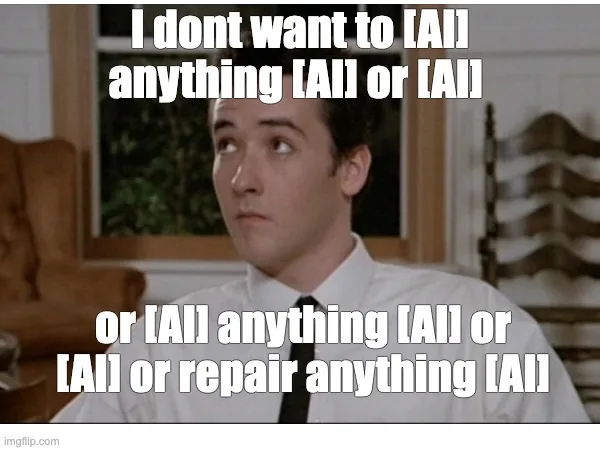
There’s an iconic scene in 1989’s Say Anything where John Cusack’s character Lloyd Dobler is asked by Ione Skye’s father what he plans to do for a career. He tries to dodge the question first, but when pressed says:
I don’t want to sell anything, buy anything, or process anything as a career. I don’t want to sell anything bought or processed, or buy anything sold or processed, or process anything sold, bought, or processed, or repair anything sold, bought, or processed.
I always thought of it as a very Generation X response to the scene in 1967’s The Graduate where Dustin Hoffman’s Benjamin Braddock gets accosted by a stranger at a party:
Mr. McGuire: “I just want to say one word to you. Just one word.”
Benjamin: “Yes, sir.”
Mr. McGuire: “Are you listening?”
Benjamin: “Yes, I am.”
Mr. McGuire: “Plastics.”
Lloyd Dobler has more than a bit of Benjamin in him: both are “lost” graduates appropriate to their era, stumbling through the process of creating a future that somehow works within social expectations but also doesn’t violate their own sense of the world.
Flash forward another decade to my favorite commercial of all time, which was made by Mullen for Monster.com during the heyday of dot-com hiring (1999) and ran at the super bowl:
To give proper credit the ad “was created by Mullen Boston (now MullenLowe) with Edward Boches as creative director, Dylan Lee and Monica Taylor as both copywriters and art directors and Hungry Man’s Bryan Buckley as director,” , according to The Drum.
AI is Consuming the World
Today, the kids in the Monster.com ad would say something like “I wanna train an AI agent to do my job and get laid off while company profits soar.” Lloyd would say he doesn’t want to buy or sell anything generated by AI, or repair anything made by an AI, etc. Mr. McGuire, similarly, would be telling Benjamin just two words: Artificial Intelligence.
It’s the inescapable reality of every conversation now, at least in the microcosm of agency / digital / tech / design world that I inhabit.
Side Note: Is AI inescapable? Listen to this episode of Punk Rock HR with Laurie Ruettimann: 307: The Engineer Who Won’t Use AI with Andrew Norcross. I know Norcross and his abilities, which are very broad and deep. I respect his values and can understand the decision he’s made, and truly wish him the best. But deciding to “opt out”—to refuse to engage with AI at all—feels like it essentially a choice to opt out of what is rapidly becoming the dominant paradigm of software engineering. People leave tech for many reasons, and the rise of AI will undoubtedly be one for many talented people, either voluntarily (as in Norcross’s case) or involuntarily. But that brain drain is a loss to the digital services industry and the sites/services Norcross could have built or the platforms he could continue to contribute to. The perhaps-too-easy analogy is that it is like a graphic designer who learned in the age of manual cut and paste (which to be clear was still being taught when I graduated college) refusing to take up Aldus Pagemaker. But something is wrong in that analogy – AI is not just another tool, but claims to be a more fundamental shift.
Of course, what made all of those scenes funny is the utter banality of what they describe: the ambition of middle management and office drudgery; generic processing, buying, selling and repairing; plastics. (Don’t come at me plastics folks). What is supposed to be the height of ambition to the young college graduate is contextualized in what the cynical viewer recognizes as a much less glamorous reality.
Is It Really About the AI?
There is a common argument that you’ve likely heard if you’ve expressed any concern about the impact of AI on your career development: “AI won’t take your job, but someone who knows how to use it better than you might.”
That platitude is cold comfort to those whose jobs were eliminated in significant layoffs across the tech and digital services industries over the last two years, especially in places where those layoffs accompany rising profits and are sometimes explicitly identified (rightly or wrongly) as being made possible by productivity enhancements of AI. (“These layoffs made possible by Large Language Models and Generative AI”). Like folks leaving tech, layoffs happen for many reasons but it looks less like “someone who knows how to use AI” replacing those laid off and more like “your job may be eliminated” altogether.
While I would certainly not say there is a consensus here, I am feeling something of a shift in perception which I hope is a move back to caution about the productivity impact of AI. Sam Altman’s recent admission he was “pretty wrong” about how quickly AI would eliminate roles. Jensen Huang of Nvidia says that connecting AI to job losses is “just too lazy” and says companies are “AI-washing” to hide the other reasons for their layoffs (see this article in Fortune). Multiple companies (Amazon, Uber, Meta, Microsoft) have backed off of strategies that had the effect of encouraging “Token-Maxxing,” reducing spend and encouraging a more measured “use AI where it makes you more productive and has positive impact” stance that sounds so profoundly reasonable one wonders why it was ever not the point.
Maybe, it turns out, AI isn’t delivering the massively overpromised revolution in productivity at enterprise scale.
What’s a Human To Do?
The standard advice: get better at AI. But concepts like “learn AI,” “do AI,” or even “get better at AI” in the generic sense are also still not the right approach, unless you really are trying to become a developer of Artificial Intelligence tools directly (though even there you probably need to specialize in a more specific area).
The goal should be to identify:
- Where AI might legitimately make you more productive at doing what you already do: increase your output and your impact
- How you can leverage your expertise, context knowledge, empathy, judgement, and taste to improve the results your projects, colleagues and companies get – when they are using AI and when they are not
- What you want to make happen in the world, the kind of people you want to do it with, and where those people are working
It’s still a case of figuring out what you love doing (in the abstract sense – it may not be specifically kickboxing that makes your career), what people might be willing to pay you to do, and how the world of business intersects with those two.
Importantly, from my perspective, the only way to really figure out where AI might legitimately make you more effective at reaching your goals is to get hands on, experiment, and try out different strategies, evaluating their success not by whether or not they “used AI” but whether they improved outcomes in a way that is worth the risks and costs the use of AI added.
There may be things you love doing—for Lloyd Dobler it was kickboxing—that become side hustles or even hobbies. But there also may be parts of what you love doing that can translate into actual jobs and careers (personal trainer? promoter?). If you’re passionate about something enough to be interested in how all the available tools (including AI) can help do that thing, that’s what you ought to be exploring.
Or there’s always the option to “opt out” altogether, and seek roles where AI has little impact. You might find more enjoyment in that, so long as it doesn’t block off your financial goals.I call this the “get out of tech and run a record store” strategy, though my guess is even record store owners are now leaning into AI for many things.
What’s your experience been? What are you seeing in your own agencies and companies?
Discover more from John Eckman
Subscribe to get the latest posts sent to your email.
Leave a Reply